This week has not gotten better from past weeks when it comes down to my health aspect. I have been having trouble sticking to my diet and finding time for the gym. I did go to the gym a few times this week, but I always feel guilty when I did not make it as much as I had hoped. Going to the gym will not do anything if I am not keeping up with healthy eating habits, but I just can’t seem to kick the junk food this week.
(Sorry for the dirty mirror)
Since I was young, I have had trouble with binge eating, it is an unhealthy coping mechanism that I have that I will probably have to fight off my whole life. The behavior has become addicting for me at times and lately it has been hard for me to pull myself away from compulsively eating 3 days worth of calories. Food addictions and binge eating are not in the book as a type of addiction, but it seems to fit the definition of a process addiction pretty well; “known to be addictive because they are mood altering” (Donatelle, 2019, p.130). I know for me, eating an abnormal amount of ice cream helps my mood very short term. I know that it only effects my mood short term which makes it hard sometimes to stop because I have built up a tolerance in a way, so I just keep eating until I feel like I am going to explode.
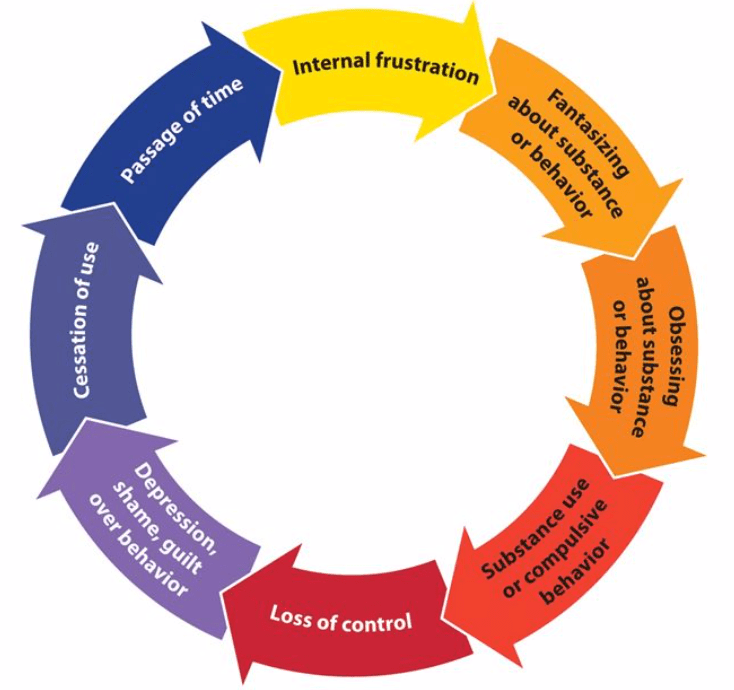
figure 6.1 Donatelle, 2019, p. 128
Above is the cycle of psychological addiction and I think that it really lays out what addiction is like step for step. Take me and food, for example, I start my relapse into binge eating due to some trigger or stressor. In this case, my stressor is my overwhelming course load, as well as an internship, 2 jobs and 6 dogs to take care of. This is the point in the semester where I start to get a bit burnt out and stressed out, so I often fantasize about food that would be really good and comforting, then I lose control and end up getting said food. After I eat enough for a small family I feel extremely guilty about the fact that I binged and after a few times I usually try to get myself to stop the behavior… until some time passes and the cycle repeats itself. It is not an easy cycle to break, and I struggle with it every day considering food is such a prevalent thing in everyones day to day life. This is a big reason why I chose a healthier diet/ lifestyle as my health aspect to work on, not because I thought it would be easy, but because it is something I could really benefit from.
Switching gears to a much more detrimental addiction, heroin, which as Donatelle(2019, p. 141) explained, is a depressant that can cause drastic mood swings, but typically keep the user in a dreamy and drowsy state. The textbook talks a lot about the physical symptoms of addiction, but does not talk about how people behave. People will go to extreme measures to try to keep people from knowing that they’re an addict or to get money for more drugs. I once lived with a heroin addict. This girl shaved her head to convince my family and I that she had ovarian cancer. When she would go to “chemo”, she was actually just getting high. When she showed those physical signs (drowsiness, mentally slow feeling), we associated it with chemotherapy, when it was actually the heroin. She ended up stealing a lot of money from my parents before we found out that she was hiding her addiction. I always did wonder, why did she lie about her addiction? Was it because she did not think we would let her live there if she was a junkie, or was it because she had an easy way to get money from us, or was she just ashamed of her habits? These are just a few questions that the people around an addict might ask. If I had been closer to her maybe having an intervention may have helped her.
 Aryana's Blog